The exciting world of drone-powered pet rescue and what to do when dogs go into wild survival mode!
Sometimes when a pet goes missing, especially in rural areas, the easiest way to get a sighting is using a drone. But where would you even start to find a drone and a willing pilot? Fortunately Drone SAR for Lost Dogs are a completely free service, and you only have to post a request on their facebook group and they will instantly mobilise their team of volunteers to help get your pet home.
We sat down for a chat with Graham Burton, founder of Drone SAR for Lost Dogs (search and rescue), the UK’s first, largest and only free drone pet reunification service and partner of PetDatabase.com, to find out more about how the service works and also how a dog’s behaviour changes when it goes into wild survival mode.
So Graham, tell us a bit more about Drone SAR for Lost Dogs, it sounds too good to be true!
You can believe us! We are 100% free, and will always be so. Drones are increasingly being used to locate missing dogs, and private pilots can charge hundreds of pounds because it is still such a specialist service.
We are different – we are volunteer run and growing fast! We currently have over 3000+ volunteer registered pilots across the UK, they range from hobby pilots, to CAA approved highly qualified pilots. Plus, we also have over 2500 ground searchers who work with the pilots and admins that work from home to coordinate the searches, plus we have 62,000 members who share posts and support that way.
As well as the manpower needed to locate and trap a dog, we also need a lot of equipment which is all funded by donations. We currently have 12 thermal drones, each one costs over £5000, plus we have traps dotted around the country which are in use for live searches.
Most importantly, we work hand in hand with DogLost and other lost and found groups – it really is teamwork that gets missing dogs home.
So how does it work?
As soon as we get notified that a pet has gone missing, we need the postcode, or if it’s really rural we can also work with what3words, which can sometimes be the easiest way to share a pin location.
We also need to know as much info about the dog, its character and behaviour, very often dogs go into survival mode, so they can behave very differently when lost.
Once we have a detailed picture we mobilise the team – we have a central office (my living room!) with a map of all the pilots across the UK and Ireland, we have local co-ordinators as well to round up the ground searchers. We can have a team out searching within hours of the pet going missing. We also make sure that the pet has been registered on DogLost UK – we work hand in hand with them. Once we have a sighting, we can direct searchers or even the owner to catch the pet.
So what happens when a dog goes into survival mode?
It’s very common for dogs that have been living wild to go into survival mode and this can make it much more difficult to catch them. It’s really important to understand their nature when they are in this state, chasing them or trying to corner them can be really counterproductive.
When a dog is in survival mode, they may not even recognise their owner – they are in primal mode, terrified, doing whatever they can to stay alive. They may roam across miles of land over a number of days until they find a place where they feel safe, usually close to a food source, which could very often be bins, or if it’s rural it may be a dead animal. They will then tend to bunker down or hide during the day, only coming out at night to feed (that’s when thermal drones are invaluable). This means we’ll very often get drone sightings of a missing dog across a huge area, but until they have settled it becomes very difficult to catch them – they are in a wild state and can easily evade humans! However, once a dog settles we have a much better chance of catching them, we will know their routine and can set up traps to catch them. The traps are big and camouflaged, and we put food, and also the owner’s dirty linen inside to entice them. They are rigged with cameras and dongles, like a ‘Ring’ doorbell but out in the wild, so whenever an animal enters the trap, a sensor closes the door and we get an instant notification. All the traps are manned so a searcher can be there in minutes. Dogs can survive for many weeks, however we never give up hope and given that they tend to all behave in the same way, we just need to be patient, logging sightings and predicting how to trap them.
They may not recognise their owner straight away, it can take minutes or even hours, but when that part of their brain kicks in, the reaction makes all the hours and days, even weeks of searching worth it!
Wow! That is impressive stealth manoeuvres! Is there anything the owner can do themselves if their pet goes missing?
The majority of rescues are simpler, and it’s important to remember that at first the dog wants to be reunited, it’s probably as anxious as the owner is! Aside from the usual good advice, put up posters, check the walking routes etc. (see our blog post ‘how to avoid losing your dog, and your mind!’) some other tricks that work are:
- Leave out dirty linen, dogs will be attracted to familiar smells. We had one owner that put her whole basket of dirty linen out at night and then went back to check at 5am before the area got busy again, and her dog was nested up inside the pile!
- Before they go into survival mode, a dog will stay close to where they were lost. Park your car there and leave the boot or a door open, or even the engine idling as your dog will recognise the sound of your car. Also, if you’re game, camp out overnight, it’s not uncommon for the dog to find its way back and jump in the car in the middle of the night.
So how did Drone SAR for Lost Dogs come about?
I’ve always been involved in pet rescue, I used to be an admin on a number of missing dog groups, and always volunteered my services as an avid drone pilot, however there wasn’t a national organisation coordinating efforts. What motivated me to start Drone SAR for Lost Dogs was when I heard about an elderly lady in Devon who lost her golden retriever and was quoted £800 a day by a drone pilot! I just thought this was totally wrong, so as I knew some friends in the Devon area with drones, I asked them if they would be willing to offer their support. Every one of them agreed, and we decided at this point to start Drone SAR for Lost Dogs. That was in 2017, 5 years later we now have over 3000 pilots! Plus we were recognised for a Points Of Light award in 2021, and we’re a current finalist in the animalstarawards.com
Found this article interesting and keen to support? Join the Facebook group, or even better you can donate using this link: paypal.me/dronesarlostdogs
Interested in seeing a real drone in action in Snowdonia – you can view here
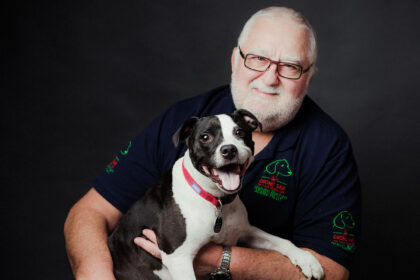
Image is of Graham and his lovely Staffie Meg!